
In November 2024, Spire Missouri Inc., Missouri’s dominant natural gas utility, filed a rate case with the Missouri Public Service Commission (MOPSC). The ongoing case (GR-2025-0107) seeks to increase customers’ energy bills by 15%, or approximately $14 per month (source). This follows a similar rate case filed just three years ago, which sought a 10–12% monthly increase (source).
I attended the June 3rd virtual public hearing and watched as more than one hundred citizens took time out of their workdays to share their opinions. Four representatives from Spire, an attorney from the Office of Public Counsel, and a MOPSC case coordinator were also in attendance to facilitate and respond to questions from the public.
During the Q&A portion of the meeting, I began to understand the true impact this rate case would have on Spire’s customers. I heard from low-income households, working mothers, customers with disabilities, environmental activists, and people from all walks of life—young adults to seniors.
Many questioned Spire’s intentions: Why file another rate case? Where would the additional funds go? I learned that Spire plans to use the increased revenue for capital investments aimed at improving the safety, reliability, and general maintenance of its natural gas infrastructure. I also learned that the company’s executives earn between $700,000 and $2.9 million annually—while continuing to petition for higher charges on customers (source).
Although it is the MOPSC’s responsibility to determine appropriate utility rates, one attendee questioned whether rate cases are ever truly rejected. Both the MOPSC coordinator and a Spire representative admitted they had never seen a rate case denied in their tenure. It’s no wonder, then, that many hearing participants pleaded with the Commission to thoughtfully consider their testimonies. It became clear to me that the lack of consumer choice, coupled with continuously rising costs, leaves customers in impossible situations with bills they simply cannot afford.
After two hours of questions, a series of commissioners and the lead judge joined the call to begin the on-record public testimonies. These statements highlighted the devastating impacts approval of this rate increase would have. Many testified that they already struggle to pay existing bills, and another increase could force impossible choices—between heating their homes and paying for medicine or groceries. One customer said they survive winter by setting the thermostat to 58 degrees and hoping the pipes don’t burst. Another woman shared that she had to request her heating be shut off entirely, unable to keep up with unexplained high bills.
This rate case poses not only severe consequences for low-income families but also serious setbacks in our progress toward clean energy. The production and use of natural gas are deeply damaging to our climate. Natural gas systems emit greenhouse gases that trap heat in the atmosphere and raise global temperatures. Methane, a primary component of natural gas, traps heat far more efficiently than carbon dioxide, making it one of the most harmful greenhouse gases (source). According to the United Nations Environment Programme, methane is 80 times more potent than carbon dioxide and is responsible for over a quarter of global warming (source). It is especially dangerous because leaks from deteriorating equipment are difficult to detect—they are odorless and colorless—and can result in super-emitter events where methane leaks for weeks undetected (source).
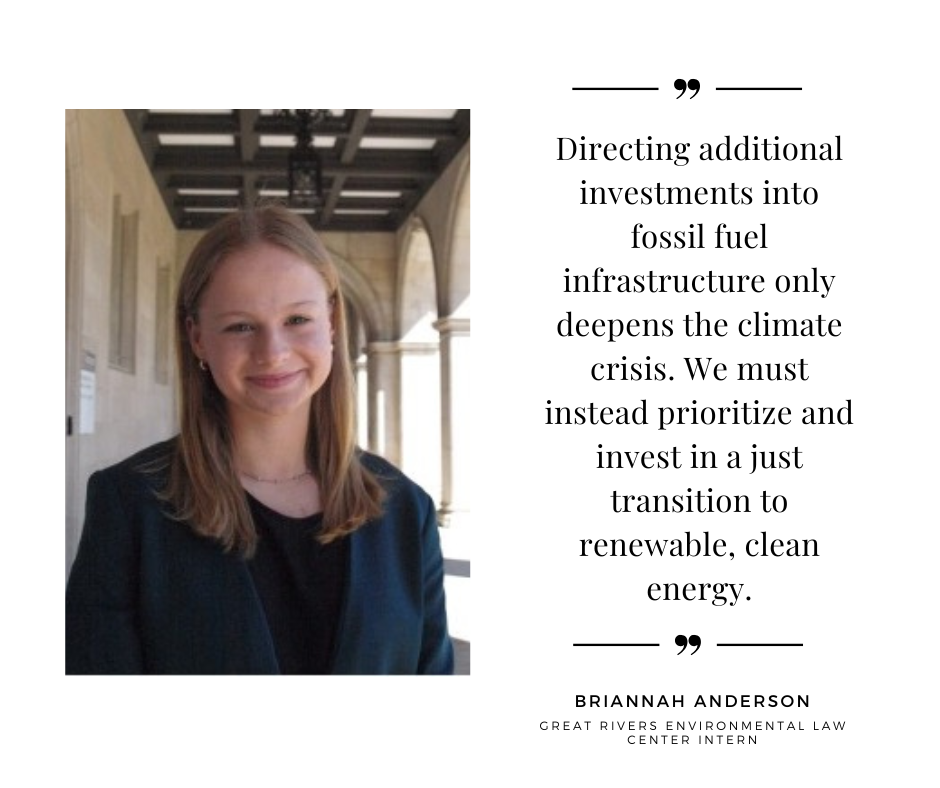
Directing additional investments into fossil fuel infrastructure only deepens the climate crisis. We must instead prioritize and invest in a just transition to renewable, clean energy.
If you’d like your voice heard in the Spire Missouri Inc. rate case, you can also submit a consumer comment to the MOPSC website and reference case GR-2025-0107.
Briannah Anderson is a Summer Intern at Great Rivers Environmental Law Center through the St. Louis Fellows program at the Gephardt Institute of Washington University in St. Louis. She is an undergraduate student studying Environmental Analysis and Anthropology on the Global Health and Environment track. She is passionate about Environmental Justice and is excited to be working with Great Rivers Environmental Law Center to advocate for public health and protect the Missouri and Southern Illinois environment.